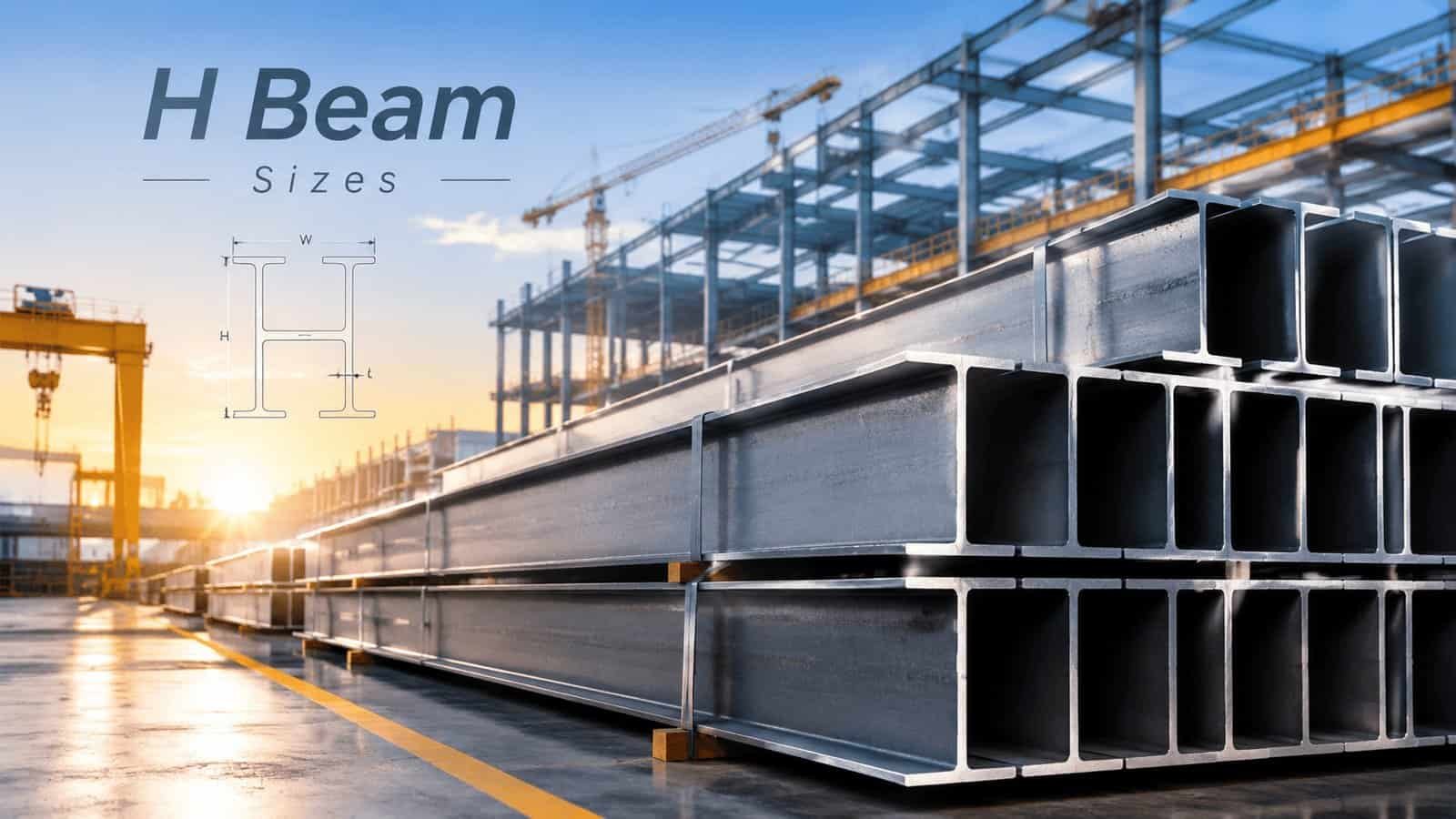
Struggling to select the right structural steel for your project? Choosing the wrong H beam sizes can lead to catastrophic structural failures or significant budget overruns. The sheer number of options is overwhelming, leaving you uncertain about which size provides the right balance of strength, greutate, and cost for your specific application.
Standard H beam sizes are a set of widely manufactured dimensions defined by their height, lățimea flanșei, si grosimea. Common metric designations include h beam 100, h beam 150, h beam 200, h beam 250, and h beam 300 (where the number indicates the beam’s height in millimeters). Imperial equivalents like the 4 inch h beam or 6 inch h beam are also standard.
Now that you have a direct answer, you’re likely wondering what those numbers really mean and how they translate to real-world projects. Let’s dive deeper into how these beams are measured, which sizes are best for certain jobs, and how your choice impacts the final cost.
How Are H Beam Sizes Actually Measured?
Have you ever looked at a spec sheet for H-beams and felt like you were trying to read a foreign language? Terms like “grosimea benzii” şi “lățimea flanșei” can be confusing. This confusion can lead to costly ordering mistakes if you’re not careful.
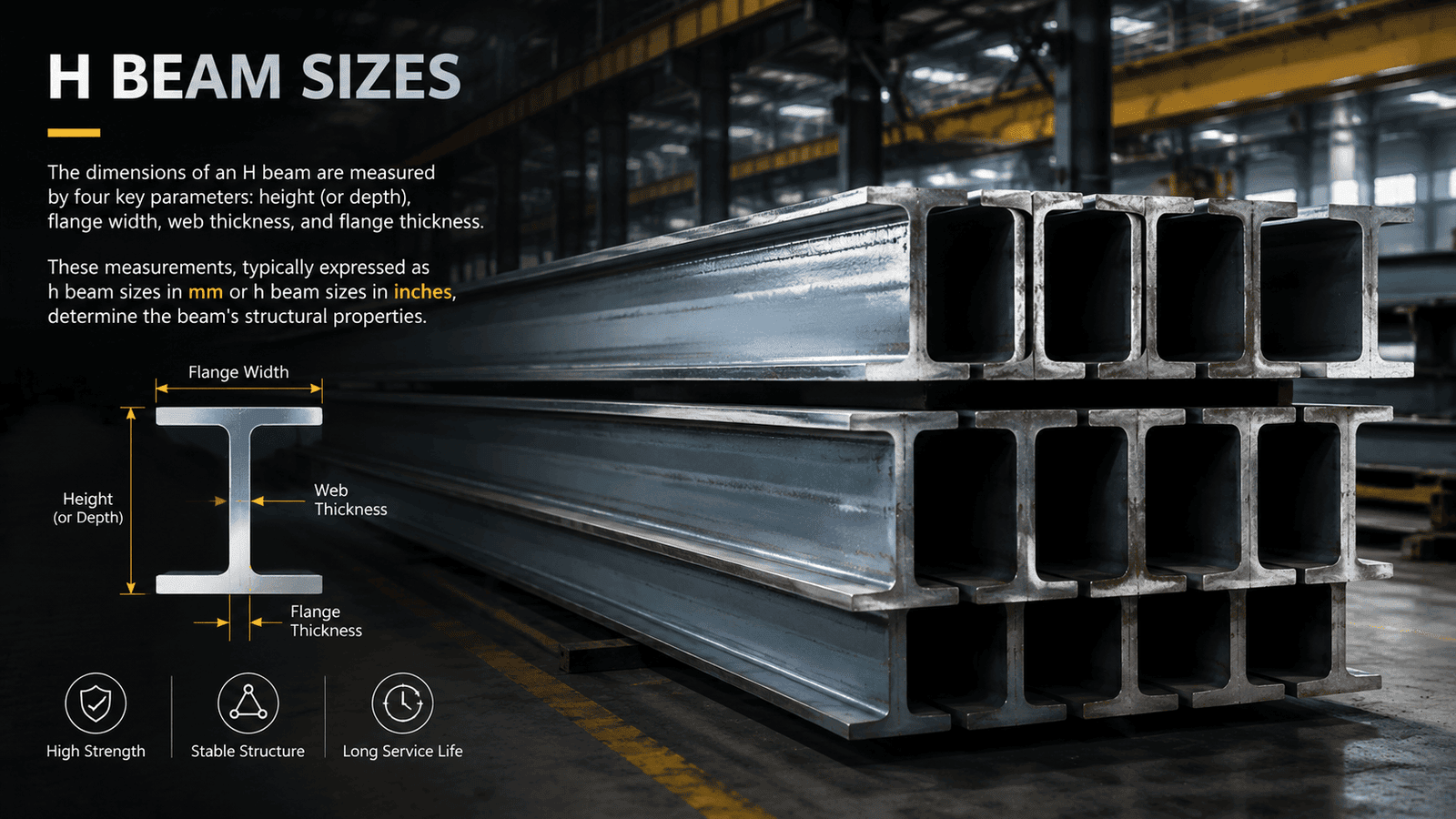
The dimensions of an H beam are measured by four key parameters: height (or depth), lățimea flanșei, grosimea benzii, and flange thickness. These measurements, typically expressed as h beam sizes in mm or h beam sizes in inches, determine the beam’s structural properties.
Dive Deeper: The Anatomy of a Structural H Beam
At its core, an h section steel beam has a simple but incredibly effective design. Understanding its parts is the first step to understanding its specifications. The name “H-beam” comes from its cross-section, which looks like the capital letter ‘H’. This shape is composed of two main parts:
- The Flanges: These are the horizontal top and bottom plates of the beam.
- The Web: This is the vertical plate connecting the two flanges.
The efficiency of a structural h beam lies in this design. The flanges are excellent at resisting bending forces, while the web resists shear forces. The combination provides immense strength with relatively low material weight compared to a solid block of steel.
Depth (Height) – The Primary Dimension
The most prominent measurement is the beam’s height, also called its depth. This is the distance from the outer face of the top flange to the outer face of the bottom flange. This dimension is what usually gives the beam its name. De exemplu:
- An h beam 200 has a nominal height of 200 millimeters.
- An h beam 300 has a nominal height of 300 millimeters.
- O 6 inch h beam has a nominal height of 6 inci.
În general, a deeper beam can span a longer distance and support more weight without bending or deflecting.
Flange Width and Thickness
The flange width is the measurement across the horizontal plates. Wider flanges provide greater lateral stability, preventing the beam from twisting or buckling under load. Flange thickness is equally critical. Thicker flanges can handle more compressive and tensile stress, which is crucial in bending applications.
Web Thickness
The web thickness is the thickness of the central vertical connector. A thicker web provides greater resistance to shear forces. This is particularly important near the ends of the beam where it rests on columns or walls, as this is where shear stress is highest.
When you see a specification like “HEB 200,” it refers to a European standard wide-flange H-beam with a nominal depth of 200 mm. The full spec sheet will then list the exact flange width, grosimea benzii, and flange thickness for that specific profile. Over my 16 years in the steel export business, I’ve seen that misinterpreting just one of these four measurements is the most common source of error for new buyers.
What Are the Most Common H Beam Sizes Used in Projects?
Are you worried about specifying a size that’s difficult to source or prohibitively expensive? Sticking to common H beam sizes can save you significant time and money on procurement. But with so many options, which ones are the true industry workhorses?
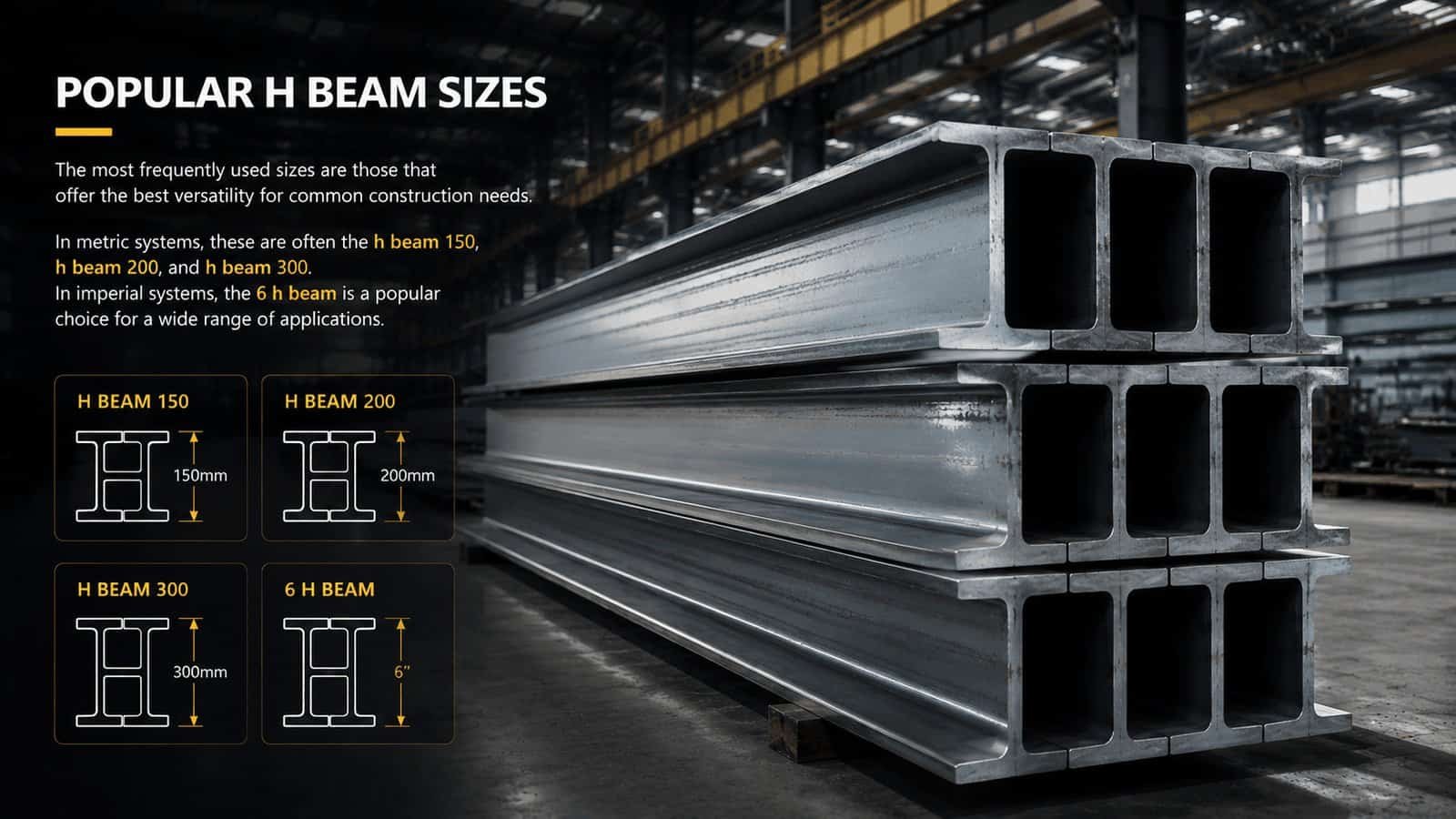
The most frequently used sizes are those that offer the best versatility for common construction needs. In metric systems, these are often the h beam 150, h beam 200, and h beam 300. In imperial systems, cel 6 h beam is a popular choice for a wide range of applications.
Dive Deeper: Matching the Size to the Application
The right h beam steel depends entirely on the load it needs to bear and the distance it needs to span. Let’s break down the common applications for different size categories. As a manufacturer, we produce these sizes daily, and I’ve seen them go into every type of project imaginable.
Small to Medium Beams (100mm – 200mm)
These beams are the bread and butter of residential and light commercial construction.
- h beam 100: Often used for lintels over doors and windows in masonry construction, short-span floor joists in mezzanines, or framing for small platforms. It’s a versatile metal h beam for light-duty tasks.
- h beam 150: A step up in strength, this size is perfect for residential floor support, roof purlins, and small retaining walls. I recently consulted with a client building a custom workshop who used our h beam 150 profiles for the entire primary frame.
- h beam 200: This is where we start entering more serious structural territory. It’s commonly used in multi-story residential buildings, commercial storefronts, and as primary support beams in larger home constructions.
Medium to Large Beams (250mm and Up)
When the loads get heavy and the spans get long, you need to size up.
- h beam 250: A very popular choice for mid-rise commercial buildings, warehouse frames, and small bridges. It offers a great balance of strength-to-weight.
- h beam 300: This is a heavy-duty beam used for industrial buildings, crane runways, and major infrastructure projects. Its depth and weight provide the rigidity needed to handle immense dynamic and static loads.
Here is a quick comparison table of these common steel h beam sizes:
| Designation | Typical Height (mm) | Typical Width (mm) | Aplicații comune |
|---|---|---|---|
| h beam 100 | 100 | 100 | Lintels, small platforms, light framing |
| h beam 150 | 150 | 150 | Residential floors, roof purlins, mezzanines |
| h beam 200 | 200 | 200 | Commercial framing, larger homes, floor systems |
| h beam 250 | 250 | 250 | Warehouses, mid-rise buildings, small bridges |
| h beam 300 | 300 | 300 | Industrial structures, heavy framing, infrastructură |
It’s important to note that within each designation (de ex., h beam 200), there can be different series (like HEA, HEB, HEM) which have the same height but different widths and thicknesses, resulting in different weight and strength characteristics. Always consult a structural engineer to ensure you select the correct profile for your specific load requirements.
How Do H Beam Sizes Affect the Final Price?
Is a bigger beam always more expensive? While that’s generally true, the relationship between H beam sizes and price is more nuanced. Not understanding these nuances can lead to you overpaying or choosing a less-than-optimal beam for your budget.
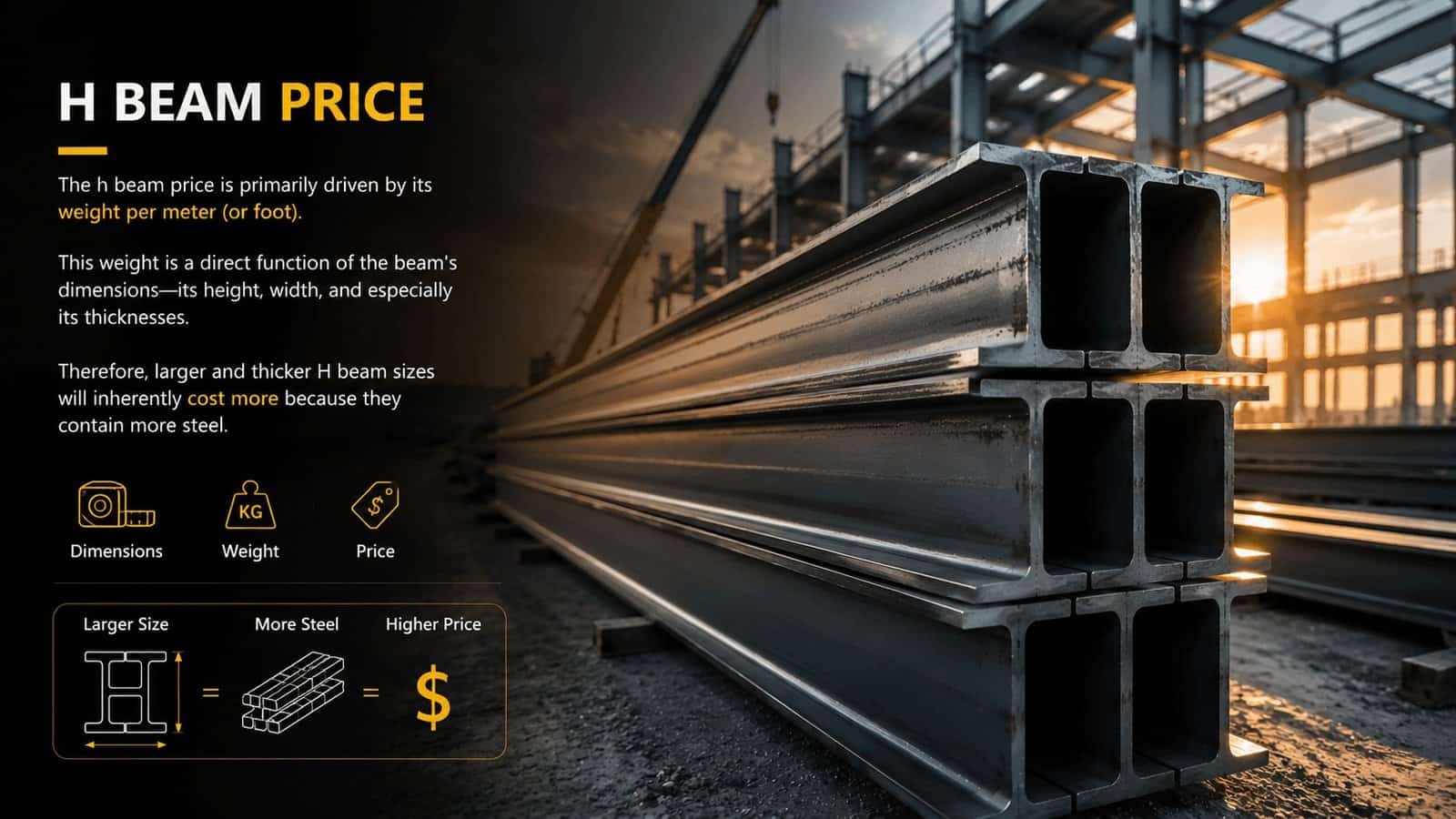
The h beam price is primarily driven by its weight per meter (or foot). This weight is a direct function of the beam’s dimensions—its height, lăţime, and especially its thicknesses. Prin urmare, larger and thicker H beam sizes will inherently cost more because they contain more steel.
Dive Deeper: Unpacking the Cost Factors
When you’re looking for steel h beams for sale, the sticker price is influenced by more than just the raw dimensions. As a manufacturer focused on providing competitive pricing for our global partners, we manage these factors daily. Understanding them will help you make a more informed purchasing decision.
The Direct Link Between Weight and Price
Steel is a commodity sold by weight (de ex., per ton or per kilogram). The most critical factor in determining the cost of an h beam is its “linear mass” sau “mass per unit length,” usually expressed in kg/m or lbs/ft.
Let’s compare two beams:
- A lighter beam profile might weigh 20 kg per meter.
- A heavier profile of the same height could weigh 45 kg per meter.
Even if the steel price per ton is the same, the heavier beam will cost more than twice as much for the same length. This is why h beam sizes and prices are inextricably linked. When you request a quote, suppliers will calculate the total weight of your order and multiply it by the current rate for that specific steel grade.
The Influence of Steel Grade
Not all h beam steel is created equal. Different grades of steel have different chemical compositions and mechanical properties, which also affect the cost.
- Standard Carbon Steel (de ex., S235JR): This is the most common and cost-effective option for general construction.
- High-Strength Steel (de ex., S355JR): This grade is stronger and costs more per ton. Cu toate acestea, its increased strength might allow a designer to specify a smaller, lighter beam to do the same job as a larger, heavier S235 beam. This can sometimes lead to overall project savings, despite the higher cost per ton.
Market Conditions and Customization
The global steel market is dynamic. The h beam price can fluctuate based on the cost of raw materials (iron ore, coking coal), prețurile energiei, and global supply and demand.
În plus, if you require non-standard sizes, custom lengths, or special coatings like galvanization, these will add to the final cost. La Yuanchi, we have the flexibility to produce custom sizes, but it’s important for buyers to know that standard profiles are generally the most economical choice due to mass production efficiencies. If you see generic h beams for sale, they are almost always standard sizes.
Can You Use H Beam Sizes for Retaining Walls?
Are you planning a retaining wall and only considering traditional materials like concrete blocks or poured concrete? These methods can be slow, labor-intensive, and require extensive excavation. There is a stronger, faster, and often more effective solution using steel.
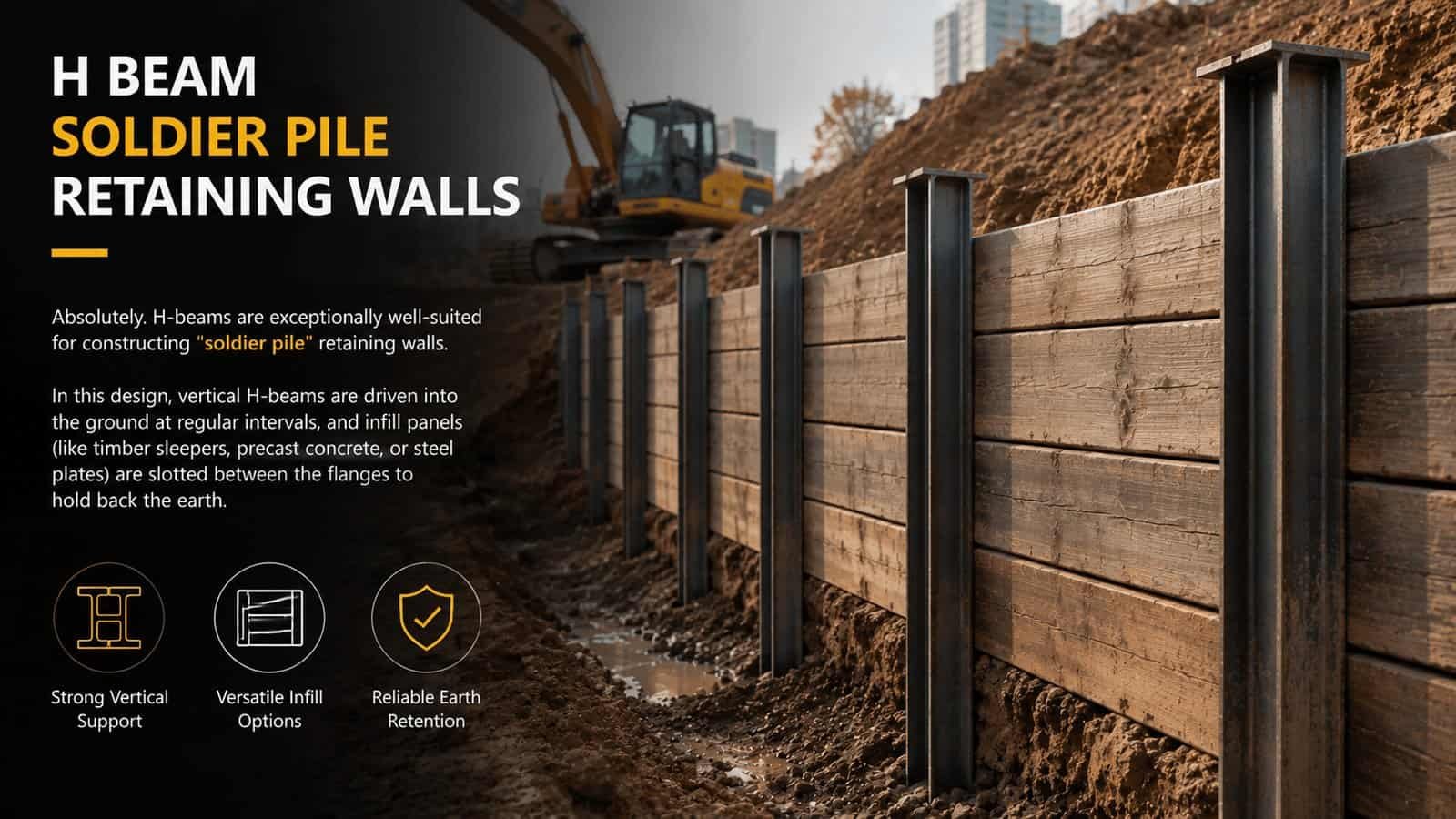
Absolutely. H-beams are exceptionally well-suited for constructing “soldier pile” retaining walls. In this design, vertical H-beams are driven into the ground at regular intervals, and infill panels (like timber sleepers, precast concrete, or steel plates) are slotted between the flanges to hold back the earth.
Dive Deeper: Building a Better Wall with H-Beams
Using h beams for retaining walls has become an increasingly popular method in both civil engineering and residential landscaping projects. The system’s strength and installation speed make it a superior choice in many scenarios. Over the years, we’ve supplied countless tons of H-beams for exactly this purpose, from small garden walls to large-scale highway embankments.
Why the H-Beam Shape is Perfect
The unique cross-section of an h beam metal profile is what makes it so effective for this application.
- Structural Channel: The space between the two flanges creates a perfect channel or slot. Once the beams are set in place, infill panels can be easily slid down into this channel, creating a solid barrier.
- Superior Bending Strength: The primary force on a retaining wall is lateral pressure from the soil behind it. An H-beam, oriented with its web parallel to the wall face, has incredible strength to resist this bending force without failing.
- Installation Efficiency: Driving steel piles into the ground with a vibratory hammer or drop hammer is significantly faster than excavating for a concrete footing, setting up formwork, and waiting for concrete to cure. This can shave weeks off a project timeline.
Selecting the Right Size for the Job
The correct size of h beam depends on several factors, primarily the height of the wall and the type of soil it’s retaining. A geotechnical engineer must perform calculations to determine the required embedment depth and beam size.
- For low residential walls (under 1.2 meters / 4 picioarele): A smaller beam like an h beam 100 or a 4 inch h beam might be sufficient in stable soil conditions.
- For medium-height walls (1.2 la 3 meters / 4 la 10 picioarele): A more substantial beam like an h beam 150 or a 6 inch h beam is typically required. These are very common sizes for this application.
- For tall commercial or civil walls (over 3 meters): Heavy-duty beams like the h beam 200 or h beam 250 are necessary to handle the immense soil pressures.
For any retaining wall application, especially near coastlines or in wet environments, we always recommend hot-dip galvanizing the beams. This protective zinc coating is essential for preventing corrosion and ensuring the long-term integrity of your h beam steel structure.
Întrebări frecvente
What is the difference between an H-beam and an I-beam?
The main difference is in the flanges. An H-beam typically has thicker, wider flanges that are parallel to each other, giving it a true ‘H’ formă. An I-beam often has tapered flanges that are thinner than the web. H-beams are generally stronger and better at handling multi-directional loads.
How do I know which H beam sizes to choose for my project?
You must consult a qualified structural engineer. They will analyze the specific loads, spans, and building codes applicable to your project to calculate the exact size and grade of h beam required. Choosing a size based on guesswork is extremely dangerous and can lead to structural failure.
Can I get custom H beam sizes manufactured?
Da, many manufacturers, including us at Yuanchi, can produce custom sizes to meet specific project requirements. This can be useful for unique architectural designs or restoration projects. Cu toate acestea, keep in mind that custom orders may have higher minimum order quantities (MOQ-uri) and longer lead times than standard stock sizes.
What does the number in “h beam 200” mean?
The number in a metric H-beam designation like “h beam 200” almost always refers to the nominal height (or depth) of the beam in millimeters. Aşa, an h beam 200 is approximately 200 mm tall. This convention makes it easy to quickly identify the general size of the beam.
Concluzie
Navigating the world of H beam sizes doesn’t have to be complicated. The key is understanding that dimensions—height, lățimea flanșei, and thickness—directly dictate a beam’s strength, greutate, și aplicare. Whether you’re considering a common size like an h beam 200 for a commercial frame or smaller profiles for residential use, the principles are the same. Remember that weight is the primary driver of cost, and consulting an engineer is non-negotiable for ensuring safety. Choosing the correct H beam sizes is fundamental to the integrity and financial success of any construction project.
If you’re looking for a reliable supplier of high-quality steel h beams for sale, with a wide range of standard sizes and custom capabilities, our team at Yuanchi is here to help. Cu 16 years of global export experience and a commitment to quality, we can provide you with the perfect structural steel solutions for your construction needs. Contact us today for a competitive quote.