Choosing the wrong rebar can risk your project’s safety and budget. Imagine structural failures or costly delays from a simple sizing mistake. I’ll help you understand the right rebar sizes.
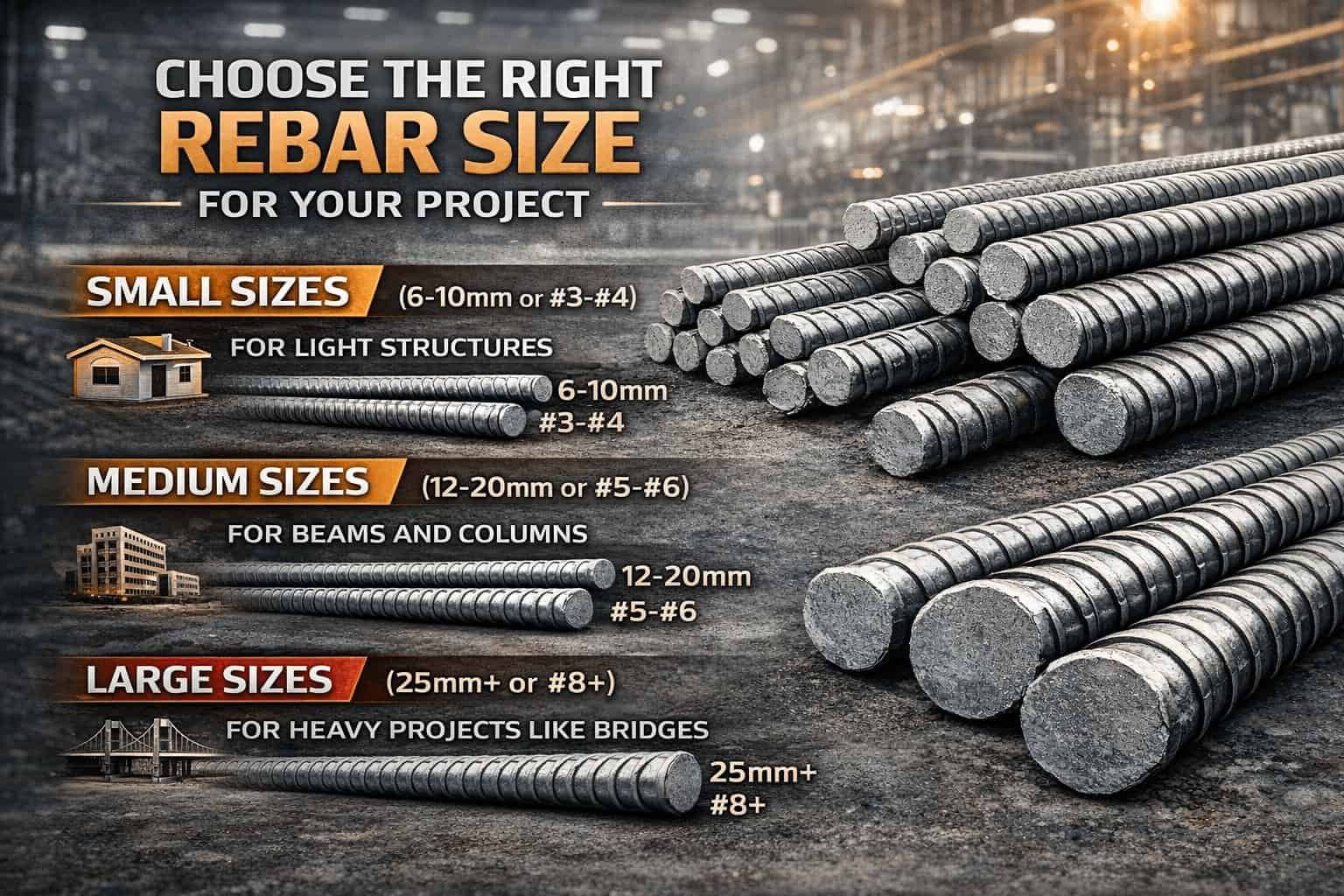
Choosing the right 철근 size depends on your project. Small sizes (6-10mm 또는 #3-#4) are for light structures. Medium sizes (12-20mm 또는 #5-#6) are for beams and columns. Large sizes (25mm+ or #8+) are for heavy projects like bridges. Always check your engineering plans.
It seems simple, but there is more to it than just small, medium, and large. I remember a time when a new client almost ordered the wrong specification for a large international project. It would have been a very costly mistake in both materials and shipping. We helped them correct it before the order was finalized. Let’s dive into the specifics so you can be confident in your next order and avoid similar problems. Understanding these details is the key to a successful build.
What Are the Common Rebar Sizes in Imperial and Metric Systems?
Are you confused by terms like #4, 12mm, and other rebar codes? Ordering the wrong size because of system confusion can stop your project. It’s a frustrating and expensive error.
The two main systems are Imperial (US) and Metric. Imperial sizes are noted with a #, like #3 (9.5mm) 그리고 #8 (25.4mm). Metric sizes are listed in millimeters, like 10mm, 16mm, 그리고 25mm. Knowing both systems is very important for international projects.
Over my 16 years in the steel export business, I’ve seen how a simple mix-up between systems can cause big problems. A client might request a #4 bar, and a supplier might think of a 10mm bar. They are close, but not the same. That small difference can fail an inspection. Yuanchi에서, we produce for a global market, so we are experts in both systems. We always double-check the required specifications to prevent these issues. It is critical to be precise.
Imperial (ASTM) 크기
미국에서는, 그만큼 ASTM standard uses an imperial system. The rebar size is given by a number. This number represents the bar’s diameter in eighths of an inch. 예를 들어, 에이 #3 철근은 3/8 inches in diameter, and a #8 철근은 8/8 신장 (또는 1 인치) in diameter.
Metric (ISO/GB/EN) 크기
Most of the world uses the metric system. This system is much more direct. The rebar size is simply its nominal diameter in millimeters (mm). 그래서, a 12mm rebar has a 12mm diameter. This is common in Europe (안에), 중국 (GB), and many other regions.
Here is a table to help you compare them:
| Imperial Size (#) | 지름 (신장) | Approx. Metric Diameter (mm) |
|---|---|---|
| #3 | 3/8″ | 9.5mm |
| #4 | 4/8″ (1/2″) | 12.7mm |
| #5 | 5/8″ | 15.9mm |
| #6 | 6/8″ (3/4″) | 19.1mm |
| #7 | 7/8″ | 22.2mm |
| #8 | 8/8″ (1″) | 25.4mm |

How Do You Match Rebar Size to Its Intended Use?
Are you thinking of using the same rebar for a foundation and a patio slab? That can be a recipe for disaster. Using rebar that’s too weak risks failure, while over-specifying wastes money.
Match the rebar size to the structural load it must support. Use small diameters (6-10mm 또는 #3-#4) for light jobs like residential slabs or stirrups. Medium sizes (12-20mm 또는 #5-#6) are standard for beams, 열, and foundations. Large diameters (25mm+ or #8+) are for heavy projects.
The key is to use the right tool for the job. You wouldn’t use a small nail to hold up a heavy frame. The same logic applies to 철근. A client once asked us for #8 bars for a simple residential driveway project. We talked it through with them. We found that #4 bars were more than strong enough for that application. This simple change saved them nearly 50% on their rebar costs and a lot on shipping. Our goal is to build long-term relationships, and that means helping our clients order correctly. Your project’s success is our success.
Small Diameter Rebar (6mm to 10mm / #3)
This rebar is for light-duty applications. It does not support major structural loads. 대신에, it helps prevent cracking from temperature changes and shrinkage.
- Uses: Residential slabs, driveways, patios, and stirrups (ties that hold main bars together in columns and beams).
Medium Diameter Rebar (12mm to 20mm / #4 에게 #6)
This is the most common category of rebar. It is the workhorse for standard construction. It provides the main tensile strength in concrete beams, 열, and foundations.
- Uses: Beams, 열, and foundations in residential and light commercial buildings.
Large Diameter Rebar (25mm and up / #8 and up)
This rebar is for projects that must support immense weight and stress. These bars are thick and heavy, providing the massive tensile strength needed for large-scale construction.
- Uses: High-rise buildings, 다리, 댐, large foundations, and other major civil engineering projects.
| 애플리케이션 | Recommended Metric Size | Recommended Imperial Size |
|---|---|---|
| Driveways & Patios | 8-10mm | #3 – #4 |
| House Foundations | 12-16mm | #4 – #5 |
| Beams & Columns | 16-20mm | #5 – #6 |
| 교량 & High-Rises | 25mm+ | #8+ |
Why Do Rebar Weight and Standards Matter So Much?
Do you think all rebar is created equal, no matter where it’s made? This idea can lead to compliance issues, budget overruns from shipping costs, and project rejection by inspectors.
철근 표준 (like ASTM, 안에, GB) define its properties, ensuring quality and compatibility. The size directly impacts weight, which is crucial for calculating shipping costs. A larger bar is much heavier, affecting your budget.
When you buy steel internationally, you are not just buying a product. You are buying a promise of quality that meets specific rules. We have 16 years of experience exporting steel from our factory in Shandong. We hold multiple certifications, so we can manufacture steel that meets ASTM, 안에, GB, and other standards. This is not just paperwork. It is your guarantee that the steel will perform as expected. Understanding weight is also key. We always provide a detailed weight breakdown in our quotes. This helps our clients budget accurately for both the material and the logistics. There are no surprises.
Understanding International Standards
Different countries have their own rules for rebar. These standards dictate the steel’s chemical composition, 인장 강도, and markings.
- ASTM (American Society for Testing and Materials): The primary standard in North America.
- 안에 (유럽 표준): Used across the European Union.
- GB (Guobiao Standard): The national standard for China.
- ISO (International Organization for Standardization): Global standards that many countries adopt.
Knowing which standard your project requires is the first step in ordering.

Calculating Rebar Weight for Your Budget
Rebar is sold by weight (per ton or per kilogram). The diameter has a huge impact on the weight. This means a small change in size can lead to a big change in cost and shipping fees. You can estimate weight to help with planning.
Here is a table showing the approximate weight for different rebar sizes:
| Metric Size (mm) | Approx. 무게 (kg/m2) | Imperial Size | Approx. 무게 (lbs/ft) |
|---|---|---|---|
| 10mm | 0.617 | #3 (9.5mm) | 0.376 |
| 12mm | 0.888 | #4 (12.7mm) | 0.668 |
| 16mm | 1.578 | #5 (15.9mm) | 1.043 |
| 20mm | 2.466 | #6 (19.1mm) | 1.502 |
| 25mm | 3.853 | #8 (25.4mm) | 2.670 |
As you can see, doubling the diameter more than doubles the weight. Always factor this into your budget calculations.
결론
Choosing the right rebar means knowing sizes, 용도, 및 표준. This knowledge ensures your project is safe, compliant, and on budget. As your partner, we are here to help.