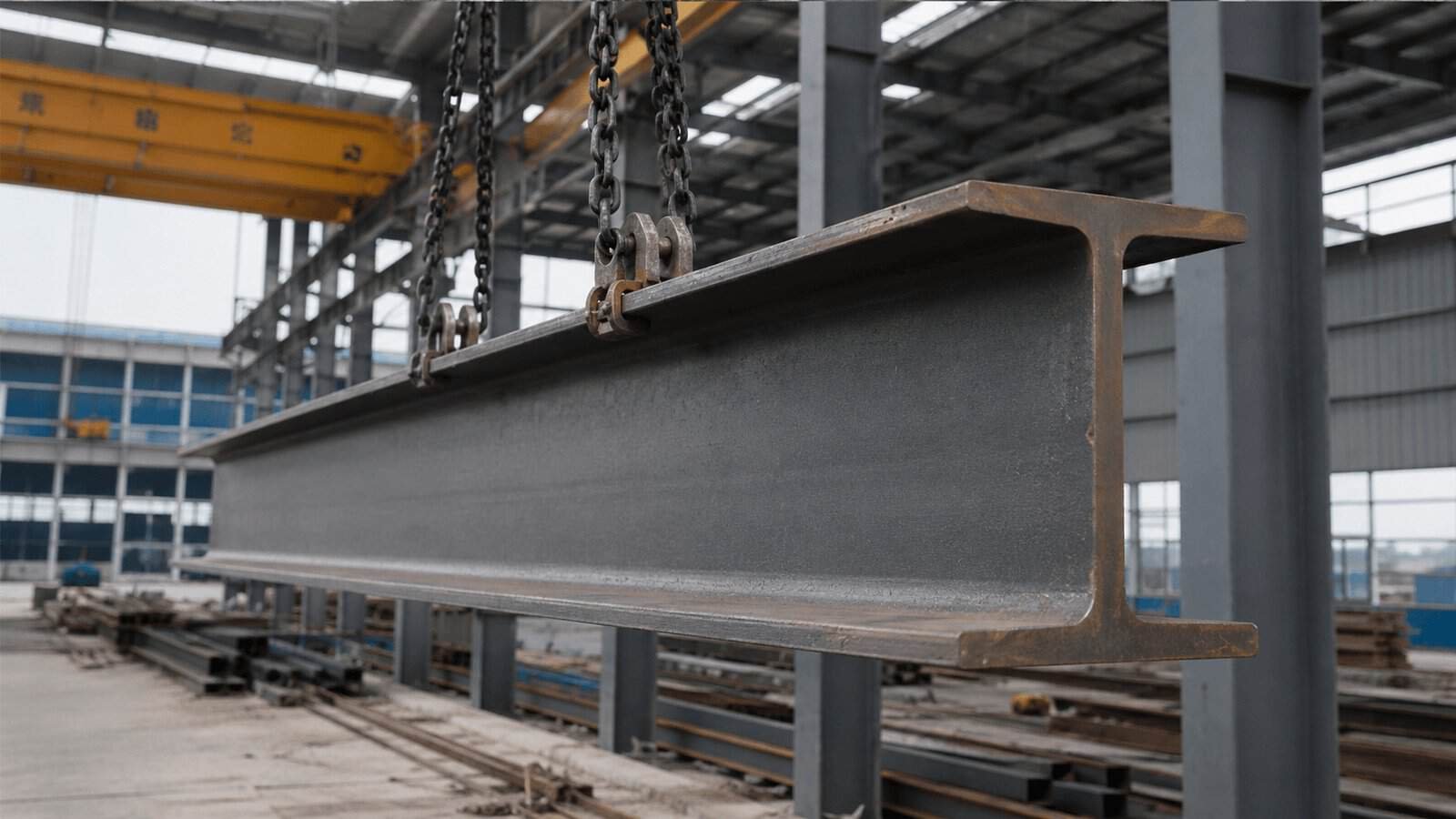
Choosing the wrong steel beam can increase costs, weaken structures, and delay projects. Understanding h beam steel sizes helps you make confident, cost-effective purchasing decisions.
The right h beam steel sizes depend on structural load, span, design standards, application, and material grade. By understanding beam dimensions, peso, international standards, and supplier capabilities, buyers can select safe, economical beams that meet project requirements while reducing installation costs and long-term maintenance risks.
Let’s explore the key factors that help you choose the right H beam for every project.
What Are H Beam Steel Sizes and Why Do They Matter?
One of the most crucial choices in structural engineering and steel procurement is selecting the appropriate h beam steel tamanhos. Beam dimensions have a direct impact on strength, stability, and construction efficiency whether you’re erecting commercial buildings, pontes, armazéns, or industrial facilities.
The height, flange width, web thickness, flange thickness, and length of an H beam are all included in the term “h beam steel sizes.” Making the right size choice guarantees adequate load-bearing capacity while preventing needless material expenses. International sourcing and engineering calculations are also made easier by standardized dimensions.
Beam parameters vary depending on the job. While residential or light commercial projects might only require fewer beams, large-span industrial buildings frequently require larger portions. Comprehending standard h beam sizes guarantees conformance with local construction codes and facilitates effective communication between engineers and buyers and producers. Além disso, choosing the appropriate beam size can shorten the time needed for manufacturing, increase installation effectiveness, and lower maintenance expenses in the future. Skilled vendors can also suggest cost-effective substitutes that offer the same structural performance without raising the project’s budget.
How Are H Beam Steel Sizes Measured?
Because different standards employ different naming systems, a lot of first-time customers wonder how to read steel beam sizes. Fortunately, comparing items becomes lot simpler if you grasp the fundamental measurements.
Overall depth, flange width, web thickness, flange thickness, and beam length are commonly used to measure an H beam. An H-beam dimensions chart or h beam steel dimensions table, which contains sectional area, moment of inertia, section modulus, and permissible loads, is also offered by many manufacturers. Engineers can choose the right beam for a given structural need with the use of these technical parameters.
Por exemplo, a beam’s height, flange width, web thickness, and flange thickness in millimeters would be written as H300×300×10×15. Because ASTM, EM, and JIS standards may use different designations, foreign customers should carefully check the supplier’s h beam sizes chart before placing an order. In addition to ensuring that the supplied products meet project specifications, reading dimensional drawings and mill certifications helps prevent ordering errors. Requesting comprehensive engineering drawings prior to manufacturing is also regarded as a best practice when collaborating with foreign suppliers.
What Are the Most Common H Beam Steel Sizes?
Several basic steel h beam sizes are extensively utilized in the construction industry, even though manufacturers can create bespoke sections. International trade, inventory control, and engineering design are all made easier by these common measurements.
H100, H150, H200, H250, H300, H350, H400, H500, H600, and greater heavy-duty sections are typical h beam standard sizes. The majority of providers offer a comprehensive chart detailing the dimensions, sectional characteristics, and weight of h beams for every specification. Antes de fazer uma compra, engineers can examine several solutions with the aid of these charts.
Structural stress, span length, seismic requirements, and local building codes all influence the ideal size. Larger beams are stronger, but they also cost more to handle, carry, and install. Therefore, rather than automatically selecting the largest available section, skilled structural engineers typically optimize beam selection. Because these elements can have a big impact on the success of the project as a whole, buyers should also examine production tolerances, available steel grades, and delivery timetables. To guarantee consistent performance, many international projects specify beam dimensions coupled with ASTM A36, ASTM A572, S275, S355, or Q235 and Q355 steel grades.
How Do You Select the Right H Beam Steel Sizes for Different Load Requirements?
Beam selection is a crucial engineering choice because every building project has different structural requirements. Selecting beams only on the basis of look or cost may lead to exorbitant expenses or inadequate structural performance. Engineers and purchasers can attain efficiency and safety by knowing how to calculate steel beam sizes.
Dead loads, live loads, span length, support conditions, wind loads, seismic requirements, and the relevant building code should all be taken into consideration when choosing the proper h beam steel sizes. Before figuring out the ideal beam size, engineers usually compare data in an H-beam dimensions table and compute bending moment, shear force, and deflection.
Por exemplo, compared to a modest office structure with smaller loads, a warehouse with massive overhead cranes needs considerably larger beams. In order to withstand bending and vibration, deeper sections with stronger flanges are frequently needed for long-span bridges and industrial facilities. Por outro lado, low-rise commercial buildings or mezzanine floors could only need medium-sized beams. While choosing an inadequate beam may jeopardize structural safety, choosing an excessive beam unnecessarily increases steel consumption, transportation costs, and installation fees. Working together with skilled steel suppliers and seasoned structural engineers guarantees that the chosen beam offers the necessary strength while staying within the project’s budget. Alternative steel grades that boost performance without appreciably raising material prices can also be suggested by trustworthy suppliers.
What Is the Difference Between H Beam Steel Sizes and I Beam Sizes?
Because both H and I beams are frequently utilized in structural building, many customers evaluate them before making an order. Despite their similar appearances, they have very different shapes, tamanhos, and uses.
Compared to I beams, H beams can support larger loads and withstand bending better because of its thicker web and broader flanges. Engineers frequently discover that whereas I beams are typically utilized for lighter structural applications, H beams offer superior structural stability for columns, hefty foundations, pontes, and industrial buildings.
H beams are a great option for projects with strict structural requirements because of their broader flange design, which enhances resistance to torsion and distributes loads more evenly. I-beams typically weigh less and could be a more cost-effective option for lighter loads or shorter spans. In addition to dimensions, buyers should consider material grade, fabrication needs, and long-term performance before making a purchase. Engineers can choose the profile that offers the optimum balance of strength, durabilidade, and cost-effectiveness by examining the mechanical characteristics of each section as well as the h beam steel parameters. Because they offer more design freedom and can better handle future building extensions, H beams are favored in many commercial projects.
Are H Beam Steel Sizes the Same Under ASTM, EM, and JIS Standards?
Several manufacturing standards are used in the international steel trade, and consumers frequently question if beam sizes are interchangeable. Comprehending these standards facilitates global sourcing and helps avoid specification errors.
ASTM, EM, and JIS standards use various nomenclature systems, dimensional tolerances, steel grades, and mechanical property criteria, despite the fact that many standard h beam sizes appear to be equivalent. Before confirming an order, it is crucial to compare the h beam dimensions chart provided by a supplier with the project parameters.
Por exemplo, JIS standards are widely utilized in Japan and many Asian nations, EN standards are dominant in the European market, and ASTM standards are widely used in North and South America. Structural calculations may be impacted by variations in flange thickness, web thickness, força de rendimento, or manufacturing tolerance even when two beams have almost identical external measurements. Before shipping, professional purchasers should always ask for thorough technical drawings, relatórios de inspeção, and mill test certifications. When clients require substitutes, reputable exporters can suggest equivalent grades like ASTM A36, ASTM A572, EN S275, EN S355, Q235, or Q355 because they are knowledgeable with international specifications. Early standard compliance confirmation minimizes engineering modifications, prevents customs problems, and guarantees efficient project execution.
Can H Beam Steel Sizes Be Customized for Special Projects?
Off-the-shelf steel sections are not suitable for every building job. Customized beam specifications are frequently needed to satisfy specific technical requirements in large infrastructure projects, industrial facilities, offshore facilities, and specialty buildings. Customers may maximize both performance and cost by being aware of the customization choices.
Sim, if the manufacturer has the requisite production capabilities, h beam steel sizes can frequently be tailored in accordance with project drawings. Special beam lengths, distinctive h beam steel dimensions, higher-strength steel grades, surface treatments, and more stringent dimensional tolerances are examples of customization. Before making an order, buyers should always verify the supplier’s production range.
Because they are made especially for the project, customized beams may eliminate material waste, reduce welding, and speed up installation. Custom production, no entanto, typically entails greater tooling costs, longer manufacturing lead times, and larger minimum order numbers. Complete technical drawings, loading specifications, steel grade specifications, and inspection standards should be supplied by buyers as soon as feasible. Adicionalmente, skilled exporters can suggest changes that enhance manufacturability without compromising structural performance. Customized H beams can also include options like galvanizing, special coatings, or weather-resistant steel if corrosion resistance is crucial.
How Can You Verify the Dimensional Accuracy of H Beam Steel Sizes?
For production and installation to be successful, precise dimensions are necessary. Small variations can cause assembly issues, lengthen the welding process, or cause building dates to be delayed. Thus, a crucial component of any purchasing procedure should be quality checking.
Inspection papers, mill test certifications, and dimensional measurements should be examined by buyers to confirm h beam steel tamanhos. Compliance with contractual specifications and international standards can be ensured by comparing the delivered items with the supplier’s h beam dimensions chart, h beam sizes chart, and project drawings.
Before shipping, professional manufacturers typically check the beam height, flange width, web thickness, flange thickness, straightness, length tolerance, and surface quality. When necessary, independent verification can be carried out by third-party inspection organizations like SGS, BV, or TÜV. In order to lower the possibility of getting non-conforming products, buyers should also request photographs, measurement records, and packing lists prior to shipment. Visual inspection should verify that there are no indications of excessive rust, distortion, cracks, or transportation damage during unloading. Because continuous quality fosters long-term business ties and boosts consumer confidence, a trustworthy supplier will welcome quality inspections.
What Should International Buyers Consider When Ordering H Beam Steel Sizes?
Purchasing steel internationally entails more than just choosing the right proportions. A successful transaction depends on a number of factors, including supplier communication, payment security, logística, and paperwork. Buyers can lower risks and manage project expenses by carefully planning.
Customers should consider product quality, classe de aço, production capacity, certificações, embalagem, shipping schedules, and total landed cost when acquiring h beam steel sizes. Adicionalmente, instead of concentrating solely on the lowest quote, they should compare the sizes and costs of the various beams because cheaper prices do not always equate to better value.
The final purchase price can be greatly impacted by local import laws, freight expenses, customs charges, and changes in exchange rates. Before signing contracts, buyers should verify Incoterms, delivery dates, payment options, and insurance coverage. Prior to export, it is also advisable to get quality inspection reports, certificates of origin, and mill test certifications. Skilled exporters can assist clients in preparing all necessary shipping documents because they are aware of the documentation requirements of various nations. Buyers may track manufacturing progress, minimize delays, and prevent expensive misunderstandings that could affect project timeframes by establishing clear communication throughout the production process.
How Do You Choose a Reliable Supplier for H Beam Steel Sizes?
Just as crucial as choosing the appropriate steel beam is choosing the appropriate source. In addition to producing high-quality goods, a reputable manufacturer offers solid logistics, steady manufacturing capacity, and technical assistance during the whole purchasing process.
Complete product specifications, competitive pricing, international certifications, high-quality inspection services, and prompt communication are all characteristics of a reliable fornecedor. Adicionalmente, they should keep transparent h beam sizes and costs for various grades and standards and offer thorough information on standard steel h beam sizes, h beam standard sizes, and the weight of h beams.
Buyers should assess the supplier’s production facilities, customer references, export experience, and quality management system prior to forming a long-term partnership. Businesses with a lot of foreign experience are typically better knowledgeable about ASTM, EM, and JIS standards and are able to offer expert advice based on project specifications. Adicionalmente, dependable suppliers facilitate third-party inspections prior to shipment, provide flexible customization options, and uphold stringent manufacturing control. Above all, they place a high priority on timely delivery because delayed shipments can cause delays in building timelines and raise project expenses. Developing a connection with a seasoned exporter generates long-term value through dependable service, consistent quality, and ongoing technical assistance.
Resumo
It is necessary to comprehend measurements, norms, loads, qualidade, and suppliers in order to choose the appropriate h beam steel sizes. Safer constructions, reduced costs, and more effective foreign steel procurement are all guaranteed by careful planning.