Choosing the wrong H beam can increase costs, weaken structures, and delay projects. Understanding dimensions helps buyers avoid costly mistakes and improve project performance.
H beam steel dimensions determine load-bearing capacity, stability, peso, e custo. By evaluating beam height, flange width, web thickness, flange thickness, and project requirements, buyers and engineers can select the most suitable H beam for construction, industrial, and infrastructure applications while ensuring safety and efficiency.
Let’s explore how each dimension influences performance, custo, and structural reliability
What Do H Beam Steel Dimensions Mean?
Buyers frequently come across several dimensional values when reviewing steel specifications, which may initially appear unclear. Since each dimension directly influences strength, peso, custo, and structural performance, it is crucial to comprehend these metrics.
Beam height, flange width, web thickness, flange thickness, and beam length are all referred to as Viga H de aço dimensions. These parameters work together to define a beam’s stability, capacidade de carga, and applicability.
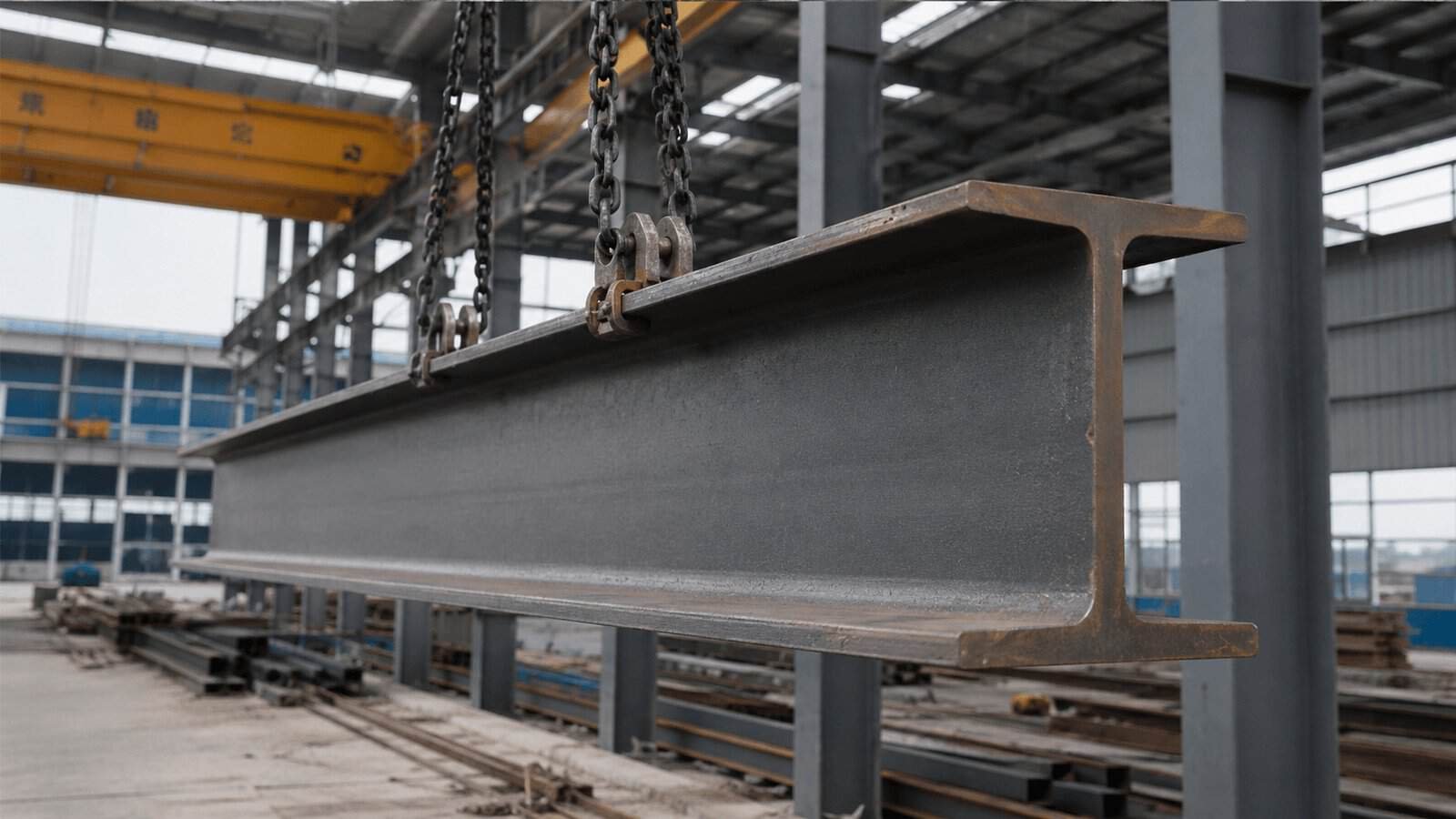
The well-known H-shaped profile of a standard steel H beam is formed by a vertical web attached to two horizontal flanges. Web thickness determines shear strength, flange width enhances stability, beam height affects bending resistance, and flange thickness influences load-bearing capacity. Buyers should consider all dimensions when examining an H beam dimensions chart because concentrating on just one measurement could result in bad structural or financial choices.
How Are H Beam Steel Dimensions Measured?
Because even small dimensional deviations can cause installation problems and compromise structural safety, accurate measuring is essential in building and production.
H beam dimensions are measured with certified instruments in accordance with international standards. Beam depth, flange width, web thickness, flange thickness, and overall length are the main measurements.
To confirm dimensions prior to export, steel producers employ precision tools like calipers, laser measurement systems, and automated inspection devices. Depending on the relevant standard, an H beam size chart typically displays measurements in millimeters or inches. Adicionalmente, buyers should check the dimensional limitations that ASTM, EM, ELE, or GB standards specify. Accurate measuring guarantees that manufactured parts fit properly and function dependably for the duration of their useful lives.
Why Does Beam Height Affect Load Capacity?
Beam height frequently has the greatest impact on structural performance out of all the dimensional characteristics. When building structures that must handle large loads, engineers usually give beam depth top priority.
A higher beam height improves the section modulus and moment of inertia, which enables the beam to handle larger loads and withstand bending more successfully.
An H beam’s vertical depth dictates how well pressures are dispersed throughout the segment. The resistance to deflection greatly improves with beam height. Por esta razão, greater H beam size criteria are frequently used in warehouses, pontes, industrial facilities, and high-rise buildings. No entanto, choosing a larger beam also results in higher installation, transporte, and material costs. To find the best solution, engineers usually weigh budgetary restrictions against strength requirements.
How Does Flange Width Influence Structural Stability?
For a beam to remain stable under a variety of loading scenarios, flange width is essential. The distribution of loads across the structure is directly impacted.
By strengthening resistance to lateral movement and improving load distribution throughout the beam section, wider flanges increase structural stability.
A large portion of the tension produced during bending is absorbed by the flanges. Particularly in long-span applications, a broader flange offers more resistance to twisting and buckling. Wide-flange steel H beam sections are used in many commercial and industrial structures because they offer a great mix between strength and efficiency. To evaluate flange widths and determine the best section for a project’s structural needs, engineers frequently refer to an H beam size chart.
What Role Does Web Thickness Play in H Beams?
Web thickness is still a crucial factor in structural performance and durability, even though beam height and flange width frequently attract the most attention.
The ability of a beam to withstand shear forces is determined by its web thickness. Under extreme loading circumstances, thicker webs offer increased strength, durabilidade, e desempenho.
The web transfers loads throughout the beam section by acting as a link between the top and lower flanges. To sustain concentrated loads and dynamic stresses, thicker webs are sometimes needed for heavy industrial buildings, mining operations, e projetos de infraestrutura. Buyers should carefully examine web thickness when examining an H beam dimensions chart because inadequate thickness could lead to deformation or a shorter service life. Long-term performance and safety are both enhanced by well-designed websites.
Which H Beam Steel Dimensions Are Commonly Used Worldwide?
Many different H beam widths are used in construction projects all around the world, based on regional standards, building design, and load requirements.
Common standard H beam sizes vary depending on national and international regulations, with beam heights ranging from about 100 mm to over 900 milímetros.
Before locating materials, many purchasers look for typical H beam sizes. H100x100, H200x200, H300x300, and H400x400 sections are typical examples. These measurements are commonly seen on an H beam sizes table and are utilized extensively in infrastructure projects, commercial structures, and industrial facilities. In order to make engineering calculations and procurement planning easier, suppliers frequently supply H beam standard sizes in millimeters, particularly in international trade where metric units are frequently favored.
How Do International Standards Define H Beam Dimensions?
Several standards organizations are involved in the international steel trade, and each one sets dimensional specifications to guarantee safety and uniformity.
Although H beam dimensions are defined variously by ASTM, EM, ELE, e padrões GB, they all seek to provide structural dependability, manufacturing consistency, and engineering safety.
The most often cited standards are GB/T in China, JIS in Japan, ASTM in the US, and EN in Europe. There may be variations in section shape, weight per meter, tolerances, and material grades even though many dimensions seem comparable. American standards typically employ imperial measures; no entanto, Chinese manufacturers typically offer H beam standard sizes in millimeters. To prevent compatibility problems, project delays, and unforeseen expenses, buyers sourcing internationally should thoroughly check dimension requirements.

How Can You Choose the Right H Beam Size for a Project?
It takes more than just picking the largest available segment to choose the right H beam. It is necessary to assess a number of engineering and commercial factors jointly.
The load requirements, span length, environmental factors, relevant standards, and project budget all influence the optimal H beam size.
Before evaluating available sections, engineers usually start by figuring out design loads and span requirements. Important details including weight, section area, moment of inertia, and section modulus can be found in an H beam dimensions table. Future maintenance needs, corrosion hazards, and environmental exposure should all be taken into account by buyers. Optimizing structural performance and preventing needless material costs can be achieved by selecting the appropriate H beam size. Both technical dependability and cost effectiveness are provided by a balanced strategy.
How Do H Beam Steel Dimensions Affect Steel Weight and Cost?
Because each increase in size necessitates more material consumption and logistical constraints, dimension selection directly affects project costs.
Dimension optimization is crucial for cost control since larger H beam dimensions result in increased steel weight, shipping costs, production costs, and installation needs.
Overall weight increases in proportion to increases in beam height, flange width, and thickness. More raw materials, more transportation capacity, and more handling resources are needed for heavier parts. In order to choose the most cost-effective alternative, buyers often use both a H beam dimensions chart and an H beam sizes chart. While choosing undersized beams may jeopardize safety and necessitate costly redesigns, choosing big beams can unnecessarily raise prices. One of the fundamental goals of steel procurement is still to find the ideal balance.
What Should Buyers Check Before Ordering H Beams?
There is more to a successful steel purchase than just verifying dimensions. Before placing an order, buyers must assess the logistical capabilities, supplier dependability, and product quality.
Buyers should confirm dimensions, material grades, certificates, relatórios de inspeção, manufacturing capacity, logistical plans, and delivery schedules prior to making a purchase of H beams.
Confirmation of H beam steel specifications, verification of H beam standard sizes, and analysis of relevant material standards should all be part of a thorough procurement evaluation. To verify compliance, buyers can ask for quality certifications, third-party inspection reports, and mill test certificates. Assessing supplier manufacturing capacity, export expertise, packaging techniques, and shipment timetables is also crucial. Reliable delivery is frequently just as crucial as product quality for distributors, empreiteiros, and government initiatives. Extensive verification lowers risks and contributes to the successful completion of projects.
Resumo
Understanding H beam steel dimensions, H beam size charts, standard H beam sizes, and H beam standard sizes in mm helps buyers optimize performance, control costs, and make confident purchasing decisions.